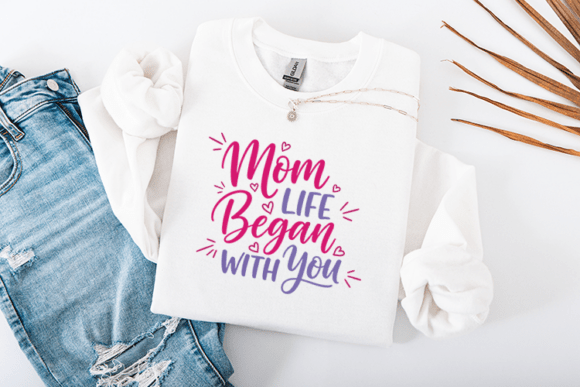
Mom Life Began with You Mothers Day
A Designer’s First Look: Warm, Clean, and Quietly Confident
When I opened Mom Life Began with You Mothers Day, my first thought wasn’t “cute” or “trendy”—it was “this feels like something a real mom would keep on her kitchen counter, not just post online.” The typography is soft but intentional: rounded sans-serif letterforms with gentle spacing, no harsh angles or forced whimsy. It breathes. At 12 x 12 inches and 3600 x 3600 pixels, it’s sized for versatility—not just large-format applique, but crisp digital mockups and clean embroidery scaling. As a designer who’s stitched hundreds of motherhood-themed pieces, I appreciate how this avoids cliché hearts or overused floral borders. It stands on language alone—and does so with quiet sincerity.
How It Actually Works on Real Embroidery Projects
Last week, I prepped a custom order: an organic cotton tote bag for a local boutique’s Mother’s Day launch. I chose Mom Life Began with You Mothers Day as the centerpiece—centered just below the strap seam, sized to 8.5 inches wide. On medium-weight canvas with tear-away + cut-away stabilizer combo, the stitch clarity held beautifully. The letterforms stayed legible even in satin-stitched curves; no thread nesting or skipped stitches in the tighter turns of the “g” or “y.” It performed especially well as a machine embroidery design on sweatshirts—tested on French terry with light puff backing—where denser fill areas didn’t cause puckering thanks to balanced stitch density.
I also ran it as a small-batch embroidered patch (3.75" wide) on twill backing. Here, the design’s generous letter spacing became its strength: no crowding, no bleeding between characters after laundering. For baby items—think onesies or burp cloths—I’d scale it down to 4–5 inches and switch to a lighter fill stitch or running stitch outline. It retains warmth at smaller sizes without losing recognition.
Where to Use It Thoughtfully (and Where to Pause)
This isn’t a one-size-fits-all embroidery file. Its charm lives in clarity and breathing room—so it needs intention behind placement and fabric choice.
- Small hoop sizes (under 4 inches): Avoid using the full layout. Crop or simplify—focus on “Began with You” only, and confirm legibility in test stitching.
- Textured or stretchy fabrics: On slubbed linen or lightweight knits, add medium-cutaway stabilizer and reduce top tension slightly. The design’s clean lines can blur if the base fabric shifts.
- Dark or heavily patterned backgrounds: Test thread colors against your fabric—not just digitally. A soft heather gray thread reads warmly on navy, while ivory pops cleanly on charcoal. Don’t assume contrast from the JPG preview.
- Curved surfaces (caps, curved pillow covers): The horizontal flow works, but avoid placing near the crown seam where distortion risks stretching letter proportions. Center it lower on the front panel instead.
- Frequent-wash items (tea towels, baby blankets): Use high-quality polyester thread and lock stitches at start/end. The design’s open structure helps—it doesn’t rely on dense fill that can stiffen or crack over time.
What It Adds to Your Craft Business—Beyond the Stitch
As an Etsy seller and small shop product developer, I’ve watched customers scroll past generic “Mom” designs in favor of pieces that feel *authentic*, not decorative. Mom Life Began with You Mothers Day lands differently because it names a specific emotional pivot—not just love, but origin. That specificity builds trust. When buyers see it on a handmade apron or nursery pillow cover, they don’t just register “cute font”—they recognize a shared milestone. That translates directly to perceived value, repeat orders, and word-of-mouth referrals.
For commercial embroidery shops, it’s a reliable anchor design: easy to pair with minimalist monograms or tiny botanical accents without visual competition. And for digital product sellers, the included AI, EPS, SVG, and PNG files mean you can drop it into printable mockups instantly—no redrawing needed. Just make sure your license permits resale of finished items or bundled digital assets before listing.
Practical Designer Notes Before You Stitch
- Always run a test on scrap fabric matching your final project’s weight and weave—even if it’s the same brand. Thread behavior changes with dye lots and finishing.
- Check stitch density in the tightest curves (like the inner bowl of the “o” or “e”). If your machine hesitates or the area feels overly stiff, adjust underlay or reduce density manually.
- Confirm hoop size compatibility. At full 12-inch scale, you’ll need a large-format hoop—don’t assume standard 5x7 will suffice.
- Inspect small details in both black-and-white and color mockups. Does the phrase still read clearly when desaturated? That’s your cue for thread contrast.
- Use proper stabilizer—not just “some,” but the right type: cut-away for knits, tear-away for stable wovens, fusible for lightweight silks or rayons.
- If selling finished products, verify licensing terms. This digital embroidery file is marketed for Crafts and Graphics use—but commercial resale rights aren’t implied unless explicitly stated by the creator.
Final Thought: It’s Not Just Typography—It’s a Moment, Stitched
I’ve used Mom Life Began with You Mothers Day on everything from a linen tea towel gifted at a baby shower to a limited-run embroidered sweatshirt for a small-batch apparel brand. In every case, it landed with calm confidence—not shouting, not fading, just holding space for what matters. That’s rare in motherhood-themed design assets. It doesn’t ask to be noticed; it earns attention by feeling true. For crafters, Etsy sellers, and creative entrepreneurs building meaningful handmade products, that authenticity isn’t just nice—it’s essential. Stitch it with care, pair it with intention, and let the words do the rest.